How Patent Enforcement Can Affect Product Strategy
Product strategy involves more than developing innovative ideas and bringing them to market. Businesses must also consider how intellectual property rights influence product design, commercialisation, competition and long term growth. Patents play a significant role in this process because they can protect technical innovations while limiting how others use patented inventions without permission.
Patent enforcement is often viewed as a legal activity undertaken when infringement occurs. In practice, it can influence product decisions much earlier. A competitor’s patent may affect the choice of technology, while enforcement against an infringing product may require a company to reconsider its design, pricing or launch plans.
For businesses operating in technology driven sectors, understanding the relationship between patent enforcement and product strategy is essential. A well planned approach can help companies protect their innovations, manage commercial risks and make informed decisions about future development.
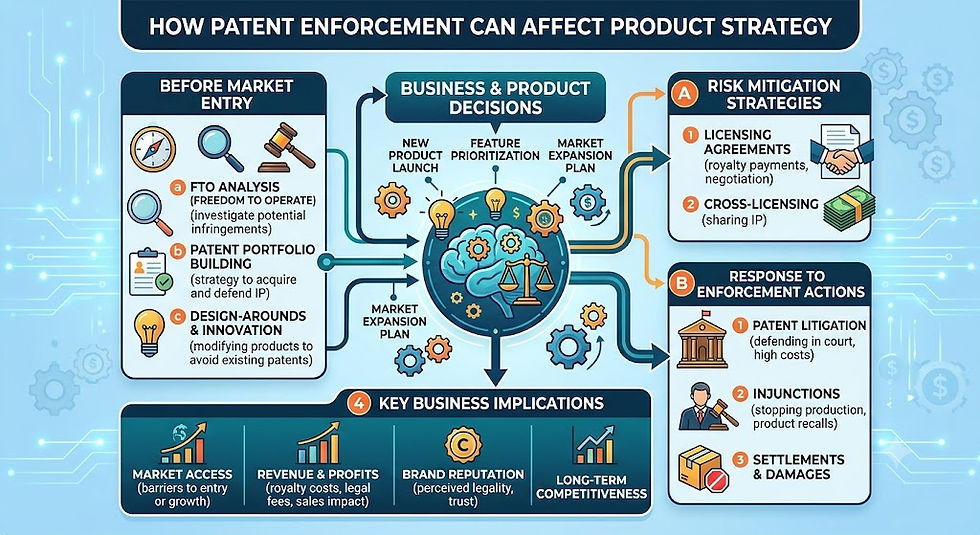
Understanding the Link Between Patent Enforcement and Product Strategy
Patent enforcement refers to the legal and commercial measures used to protect patent rights against unauthorised use. Depending on the circumstances and applicable law, these measures may include sending a legal notice, seeking an injunction, pursuing damages or negotiating a licence.
Product strategy determines how a business develops, positions and sells its products to achieve commercial objectives. Although these functions serve different purposes, they often intersect. A patent dispute can affect the technologies a company uses, the markets it enters and the resources it allocates to research and development.
For example, a manufacturer planning to introduce a new electronic device may discover its design uses a component covered by a competitor’s patent. The company may need to assess whether the patent is valid, whether its product falls within the patent claims and whether a licence is commercially viable.
These questions can influence the product roadmap long before a dispute reaches court. Businesses which consider patent risks during the planning stage are often better placed to avoid expensive changes after development is complete.
Influencing Product Design and Innovation
Patent enforcement can directly affect how companies approach product design. When a product incorporates technology protected by another party’s patent, the business may need to redesign the relevant feature, obtain permission to use the invention or consider an alternative technical solution.
Such decisions can affect development costs, product performance and launch schedules. A redesign may require additional engineering work, further testing and changes to manufacturing processes. In regulated industries, significant modifications may also require additional compliance assessments.
However, patent restrictions can encourage innovation in other ways. Engineers may explore alternative methods of achieving the same result, leading to new technical solutions and potentially valuable intellectual property of their own.
This approach is often described as designing around a patent. It requires careful analysis of the patent claims rather than simply changing the appearance of a product. A minor modification may not avoid infringement if the revised product still falls within the scope of the relevant claims.
Companies should therefore involve intellectual property professionals during early design reviews. A timely assessment can help teams identify potential conflicts, compare technical alternatives and make decisions before significant development resources are committed.
Shaping Market Entry and Product Launch Decisions
Patent disputes can influence when and where a business launches a product. A company entering a market with established competitors may face greater exposure to patent claims, particularly in sectors where numerous patents cover interconnected technologies.
Pharmaceuticals, medical devices, telecommunications and advanced manufacturing are examples of industries where patent rights can have a substantial influence on commercialisation. A single dispute may delay a launch, restrict distribution or increase the cost of entering a particular market.
Businesses should assess relevant patent rights in each intended jurisdiction. Patent protection is territorial, meaning a patent granted in one country does not automatically provide the same rights elsewhere. However, a product manufactured in one country may still raise infringement concerns when imported or sold in another country where a relevant patent is in force.
Freedom to operate assessments can help companies evaluate whether their planned activities may conflict with existing patent rights. These assessments do not guarantee immunity from litigation, but they can identify potential obstacles and inform launch decisions.
When a significant risk emerges, a business may reconsider its launch sequence, negotiate a licence or modify its product offering. Such choices should reflect both the legal position and the commercial importance of the affected market.
Affecting Competition and Commercial Positioning
Patent enforcement can influence the competitive balance within an industry. A company holding valuable patent rights may use enforcement to prevent competitors from exploiting protected technology without authorisation. This can help preserve the commercial advantage associated with research and development investment.
For businesses accused of infringement, the consequences can be equally significant. Litigation costs, potential damages and restrictions on sales may weaken market position, particularly when the disputed product represents a major share of revenue.
Patent disputes can also affect pricing decisions. Licensing fees or royalty obligations may increase production costs, while the removal of a product feature may alter its perceived value. Businesses must consider these factors when assessing profit margins and competitive positioning.
Nevertheless, patent enforcement does not automatically prevent competition. Competitors may develop alternative technologies, challenge the validity of a patent or negotiate commercial arrangements. The outcome depends on the scope and strength of the patent rights, the evidence available and the relevant legal framework.
Companies should assess patent enforcement as part of their wider competitive strategy rather than treating every dispute as an isolated legal matter.
Influencing Licensing, Partnerships and Investment
Patent enforcement can encourage businesses to reconsider how they access technology. Instead of developing every component internally, a company may obtain a licence from a patent owner. Licensing can provide access to established technology while reducing the need for expensive research and development.
Cross licensing may also help businesses resolve disputes when each party owns patents relevant to the other's products. Such arrangements can support continued product development and reduce uncertainty, although their commercial and legal terms require careful negotiation.
Patent risks can influence investment decisions as well. Investors, lenders and potential acquisition partners may examine a company's patent portfolio, ongoing disputes and exposure to third party rights before committing capital.
A business with unclear ownership records or unresolved infringement concerns may face additional scrutiny during due diligence. In contrast, a well managed patent portfolio and a documented approach to enforcement can provide greater clarity about the company's intellectual property position.
Seeking advice from patent enforcement lawyers in India can help businesses evaluate enforcement options, assess potential infringement risks and understand how Indian patent law may affect product development and commercialisation decisions.
Coordinating Patent Rights with Broader Intellectual Property Protection
Patent enforcement is one part of a wider intellectual property strategy. Products often combine several forms of protection, including patents for technical inventions, trademarks for brand identity, copyright for original creative works and registered designs for qualifying visual features.
A dispute involving one form of intellectual property may reveal weaknesses in another area. For example, a company developing a new software enabled product may need to consider patent eligibility, copyright ownership, contractual rights and the use of third party code.
These rights are not interchangeable. Copyright does not automatically protect an underlying technical invention, while a patent does not necessarily protect a product's branding or every element of its software.
Businesses should identify the relevant rights at each stage of product development. Clear agreements with employees, contractors and technology partners can also help establish ownership and permitted use.
Where software, digital content or creative product elements are involved, copyright protection lawyers in India may assist with evaluating ownership questions and coordinating copyright issues with the company's wider intellectual property strategy.
Building Patent Enforcement into Long Term Planning
An effective product strategy treats patent risk as an ongoing business consideration rather than a problem to address only after receiving a legal notice. Companies should review relevant patent developments as technologies evolve, competitors introduce new products and business plans expand into additional markets.
Regular portfolio reviews can help businesses identify patents worth maintaining, technologies suitable for licensing and potential infringement concerns requiring further investigation. Research and development teams should also document technical decisions and maintain appropriate records of invention development.
When a dispute arises, business leaders should work with legal, engineering, finance and sales teams to assess the available options. Continuing with the original product plan may be commercially sensible in some circumstances, while redesign, licensing or withdrawal may be more appropriate in others.
The right response depends on the strength of the legal position, the potential commercial impact and the company's long term objectives. Early communication between departments makes it easier to compare these considerations and avoid decisions driven solely by immediate pressure.
Conclusion
Patent enforcement can shape product strategy at every stage, from initial research and design to market entry, pricing and future investment. It can protect innovation and strengthen competitive advantages, but it can also create costs and operational challenges when products conflict with existing patent rights.
Businesses can manage these challenges more effectively by assessing patent risks early, exploring licensing opportunities and integrating intellectual property considerations into product planning. A coordinated approach allows companies to make informed commercial decisions while respecting the rights of other patent owners.
Ultimately, patent enforcement is not merely a response to infringement. When integrated into business planning, it becomes an important consideration in developing sustainable products, protecting innovation and supporting long term commercial growth.


Comments